

Tools for electronics hobbyists & Beginners
These are the exact electronics tools I recommend to every beginner who asks me where to start. I’ve chosen each one specifically because it’s beginner-friendly, reliable, and won’t waste your money. You don’t need anything fancy to get started — this list covers everything you need to go from zero to your first working circuit.
Total cost to get started: about $35 for the first three items (breadboard, parts kit, multimeter), or roughly $45–55 with jumper wires and a 9V battery.
Some links on this page are Amazon affiliate links. If you buy through them I earn a small commission at no extra cost to you. Prices are approximate, so check the current price.

Full-size breadboard
Why you need it: The breadboard is your main building surface. Every circuit you build as a beginner goes here first — no soldering needed. Get a full-size 830 tie-point board. The small ones are frustrating to work with.
What to look for: a full-size 830 tie-point board with power rails. Avoid: small 400-point boards, which run out of room quickly. New to breadboards? Follow this first-circuit guide.
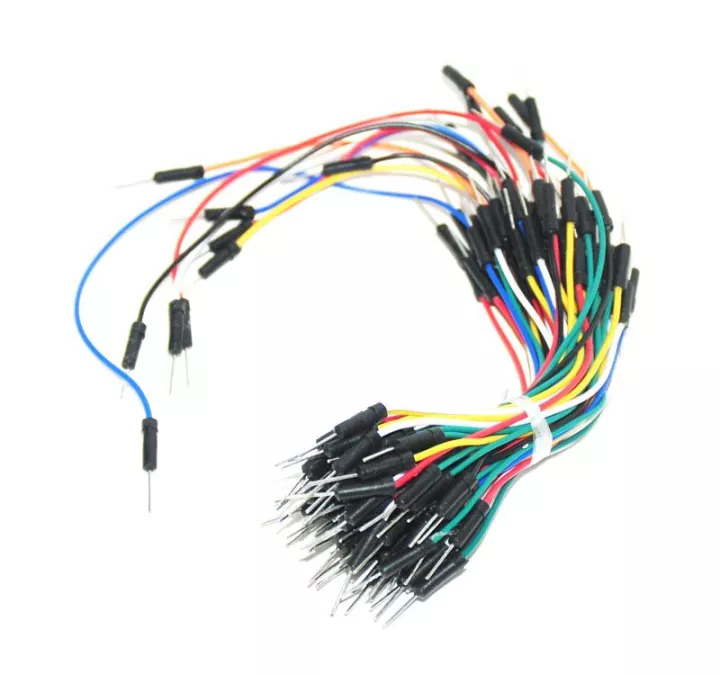
Jumper wire kit
Why you need it: Jumper wires connect your components on the breadboard. Get a kit with male-to-male wires in multiple lengths and colours. Colour-coding your connections (red for positive, black for ground) saves you from enormous confusion when troubleshooting.
What to look for: male-to-male wires in several lengths and colours.

Electronics component starter kit
Why you need it: Before you can build anything, you need components. A good starter kit gives you resistors, capacitors, LEDs, transistors, and diodes in one box. Buy a kit rather than individual parts — much cheaper, and you’ll use everything in it.
What to look for: a range of resistor values, LEDs, ceramic and electrolytic capacitors, diodes, NPN transistors and push buttons. Avoid: huge kits full of parts you can’t identify yet. More options: best electronics component kits.
9V battery + connector clip
Why you need it: For your first circuits, a 9V battery with a connector clip is all you need. Simple, safe, and easy to disconnect if something goes wrong. Once you move beyond basic circuits, you can upgrade to a bench power supply — but don’t buy one yet.
Always put a resistor in series with an LED, or the LED will burn out.

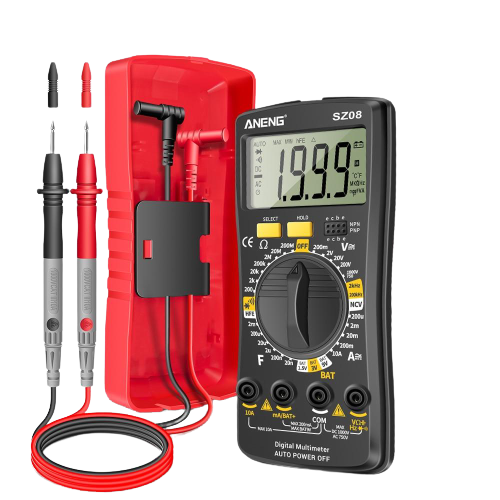
Digital multimeter
Why you need it: The multimeter is the single most important tool a beginner can own. You use it to measure voltage, current, and resistance — which means you can test every component before you build and troubleshoot when something doesn’t work. Don’t skip this. A cheap reliable one is all you need to start.
What to look for: DC and AC voltage, resistance, a continuity buzzer and a diode test, plus a fuse on the current (amps) input (check the listing). Avoid: using a very cheap meter on mains (wall) power. More choices: best beginner multimeters.
Component organiser box
Why you need it: Once you have more than one component kit your workspace gets messy fast. A small parts organiser keeps everything sorted and saves you 10 minutes of searching every time you build something. It’s a nice-to-have, not a first purchase. Buy one when the mess begins — you’ll thank yourself later.

What to buy first — the $35 starter kit
If you’re just starting out and want to keep costs low, buy these three things first and nothing else:
- Breadboard — ~$6
- Component starter kit (includes resistors, LEDs, capacitors) — ~$15
- Basic digital multimeter — ~$12
That’s it. Under $35, and you have everything you need to follow the full 5-step path and build your first working circuit. Add jumper wires and a 9V battery from a local store, and you’re ready to go. When you want more, see the best soldering kits, lab power supplies and oscilloscopes.
My book: Basic Electronics for Beginners
Ready for the full path from zero to a working circuit?
You’ve got the tools. My book, Basic Electronics for Beginners, picks up from here. It is a 158-page paperback that walks you step by step through building one real circuit.
Build one real circuit from start to finish
Understand voltage, current and components
Learn to read schematics
Learn to troubleshoot when a circuit doesn’t work
Written for complete beginners
